The VAT rise that never happened
A Budget that proposed VAT at 15.5% (later withdrawn), unadjusted tax brackets, a new minimum wage, falling SARS interest, and the new IFRS for SMEs.
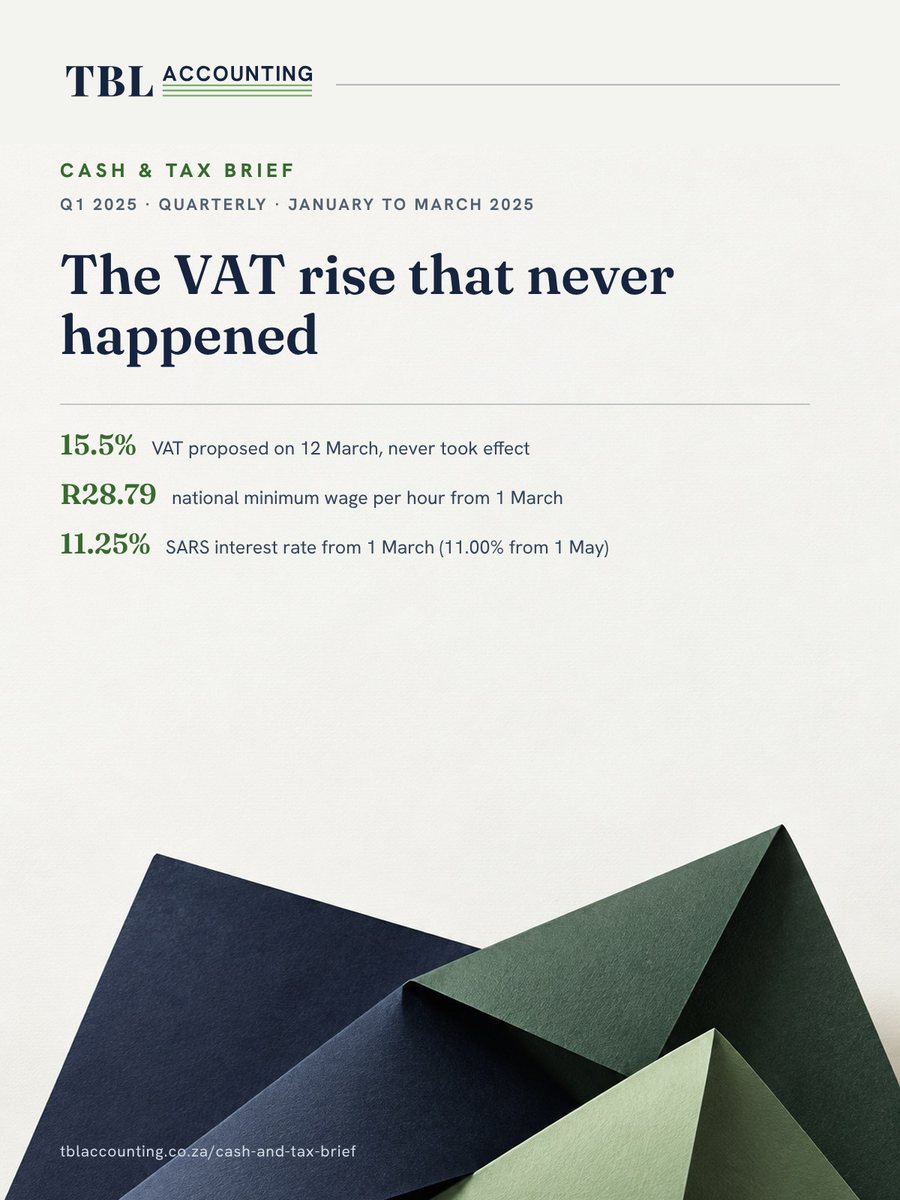
In this edition
- Budget proposed VAT at 15.5% from 1 May 2025, then withdrew the increase
- Budget 2025 left tax brackets, rebates and medical credits unadjusted for 2025/26
- National minimum wage rises to R28.79 an hour from 1 March 2025
- SARS interest on late or underpaid tax fell to 11.25% from 1 March 2025 (11.00% from 1 May)
- New SARS travel and subsistence rates: R570 a day and 476c a kilometre
- Budget funds SARS to chase non-filers and growing undisputed debt
- IASB issues third edition of IFRS for SMEs, effective 1 January 2027
- UK Self Assessment due 31 January 2025: £100 penalty even if no tax owed
- UK Finance Act 2025 passed: non-dom regime replaced from 6 April 2025
Lead story
Budget proposed VAT at 15.5% from 1 May 2025, then withdrew the increase
What changed. The Budget delivered on 12 March 2025 proposed raising VAT from 15% to 15.5% on 1 May 2025 and to 16% on 1 April 2026. On 24 April 2025 SAnews reported the increase was expected to be withdrawn when the Minister introduced the Rates and Monetary Amounts and Amendment of Revenue Laws Bill, with Treasury estimating the withdrawal would leave a revenue shortfall of some R75 billion over the medium term. The Minister said on 30 April 2025 that VAT would remain at 15%, and the Budget re-tabled on 21 May 2025 kept it there.
What it means for you. Had it proceeded, every VAT-inclusive price, invoice template and cash-flow forecast would have needed re-basing from 1 May 2025. It did not take effect: the rate stayed at 15%, but businesses that had already re-priced or reconfigured systems had to reverse that.
What we’d do. Avoid re-pricing or changing accounting-system VAT codes on a Budget announcement alone; wait for the enacted rate and effective date, and keep a short change checklist ready.
Tax and SARS
Budget 2025 left tax brackets, rebates and medical credits unadjusted for 2025/26
What changed. The 12 March 2025 Budget proposed no inflationary adjustment to personal income tax brackets, rebates or medical tax credits for 2025/26 (1 March 2025 to 28 February 2026). The Budget 2025 Tax Guide lists rates of 18% on the first R237,100 of taxable income up to 45% above R1,817,000; a primary rebate of R17,235; a tax threshold below age 65 of R95,750; small business corporations at 0% up to R95,750 of taxable income; and dividends tax at 20%.
What it means for you. With brackets and rebates unadjusted, pay rises can push more income into higher bands (fiscal drag), and owner-managers' salary and dividend mix is taxed against the same bracket structure shown in the Tax Guide.
What we’d do. Re-run owner-manager remuneration (salary versus dividend) and staff net-pay expectations using the 2025/26 tables when setting raises.
SARS interest on late or underpaid tax fell to 11.25% from 1 March 2025 (11.00% from 1 May)
What changed. SARS's interest rate table shows the prescribed rate at 11.75% to 31 December 2024, 11.50% from 1 January 2025, 11.25% from 1 March to 30 April 2025 and 11.00% from 1 May 2025. The Budget 2025 Tax Guide lists interest on late or underpayment of tax at 11.25% p.a. SARS's March 2025 digest also repeats that non-payment of SARS debt can attract a 10% penalty, with interest accumulating monthly.
What it means for you. Interest on SARS debt was 11.25% a year for the period 1 March to 30 April 2025, slightly less than the 11.50% before, and was cut again to 11.00% from 1 May 2025; a 10% penalty for non-payment can apply on top.
What we’d do. Settle or arrange payment of SARS balances promptly; interest accrues monthly at the prescribed rate in force and a penalty can apply on top.
Budget funds SARS to chase non-filers and growing undisputed debt
What changed. The 12 March 2025 Budget speech (as republished by allAfrica) said SARS is allocated R3.5 billion plus an additional R4 billion over the medium term, that SARS reported a significant increase in undisputed debt, and that SARS has identified 156 000 taxpayers who are not registered or have not filed. IOL (13 March 2025) reported the funding as about R7.5 billion in total, to help SARS pursue debt owed and outstanding returns.
What it means for you. More SARS capacity aimed at non-filers and debt collection raises the odds that late returns, unregistered activity and unpaid balances are caught and followed up.
What we’d do. Clear any unfiled returns and unregistered tax types now, and put payment arrangements in place for any outstanding SARS debt.
Payroll and employers
National minimum wage rises to R28.79 an hour from 1 March 2025
What changed. Employment and Labour Minister Nomakhosazana Meth announced on 5 February 2025 that the national minimum wage rises from R27.58 to R28.79 for each ordinary hour worked from 1 March 2025.
What it means for you. Anyone paid below R28.79 per ordinary hour must be raised from 1 March 2025, an increase of R1.21 per hour on the old rate, which flows through to PAYE, UIF and SDL bases.
What we’d do. Check the lowest hourly rates across payroll, including part-time and domestic staff, before the March payroll run and update the payroll system.
New SARS travel and subsistence rates: R570 a day and 476c a kilometre
What changed. Income Tax notices gazetted on 28 February 2025 (GG 52199, Notices 5935 and 5936) set the deemed daily amounts at R570 per day for meals and incidental costs and R176 per day for incidental costs only (accommodation in the Republic), and the simplified-method rate per kilometre at 476 cents (R4.76) at the recipient's option, for years of assessment commencing on or after 1 March 2025. The simplified method applies only if the employer pays no other allowance or reimbursement apart from parking or toll fees.
What it means for you. Employers reimbursing travel and subsistence need to update policies and payroll settings to the new amounts; payments above the prescribed amounts, or not meeting the conditions, may need to be treated differently for PAYE.
What we’d do. Update the travel and subsistence policy and payroll configuration for the new amounts from 1 March 2025, and keep logbooks and claims evidence.
Across borders: the UK and abroad
IASB issues third edition of IFRS for SMEs, effective 1 January 2027
What changed. The IASB issued the third edition of the IFRS for SMEs Accounting Standard on 27 February 2025, effective on or after 1 January 2027, with earlier adoption permitted. It revises Section 23 (revenue from contracts with customers), adds a new Section 12 on fair value measurement, introduces the acquisition method in Section 19, adopts a single control model in Section 9 and adds financial-instrument risk disclosures in Section 11.
What it means for you. If your annual financial statements use IFRS for SMEs, revenue recognition, consolidation, fair value and business combination accounting may change for periods from 2027.
What we’d do. Map current revenue contracts, group structure and fair-valued items to the new sections ahead of the 1 January 2027 effective date so any restatement is quantified.
UK Self Assessment due 31 January 2025: £100 penalty even if no tax owed
What changed. HMRC's 6 January 2025 notice reminded taxpayers of the 31 January 2025 Self Assessment deadline for 2023 to 2024. Late filing brings an initial £100 fixed penalty even if no tax is owed, daily penalties of £10 per day after three months up to £900, then 5% of the tax due or £300 (whichever is greater) at six and twelve months. Late payment adds 5% of unpaid tax at 30 days, six months and twelve months, plus interest.
What it means for you. A South African living or earning in the UK who files late faces £100 immediately, up to £900 in daily charges and further percentage penalties, plus interest on unpaid tax.
What we’d do. Check UK-resident family and directors are registered for Self Assessment and have their SA and UK income records collated well before 31 January each year.
UK Finance Act 2025 passed: non-dom regime replaced from 6 April 2025
What changed. The Finance Act 2025 received Royal Assent on 20 March 2025. Part 2 is titled 'Replacement of special rules relating to domicile' and abolishes the remittance basis for non-UK domiciled individuals, replacing it with a residence-based regime from 6 April 2025, with a four-year relief for new arrivals.
What it means for you. The non-dom rules that some South Africans in the UK relied on ended on 6 April 2025, so UK-resident South Africans' foreign income and gains become taxable on the new residence-based basis once any four-year relief runs out.
What we’d do. Check each UK-resident client's arrival year, foreign income and gains, and trusts against the Finance Act 2025 as enacted, not the October 2024 policy paper.
Get the Brief by email
General information only, correct at the date of the edition and based on the sources cited. It is not tax, legal or investment advice. Speak to your adviser before acting. The Cash & Tax Brief is general information for South African businesses and South Africans abroad. It is not tax, legal or financial advice, and it reflects the public sources linked in each item at the date shown. Rules change and proposals may not become law, so confirm the current position before you act. Information about the UK is general and is not UK tax advice.