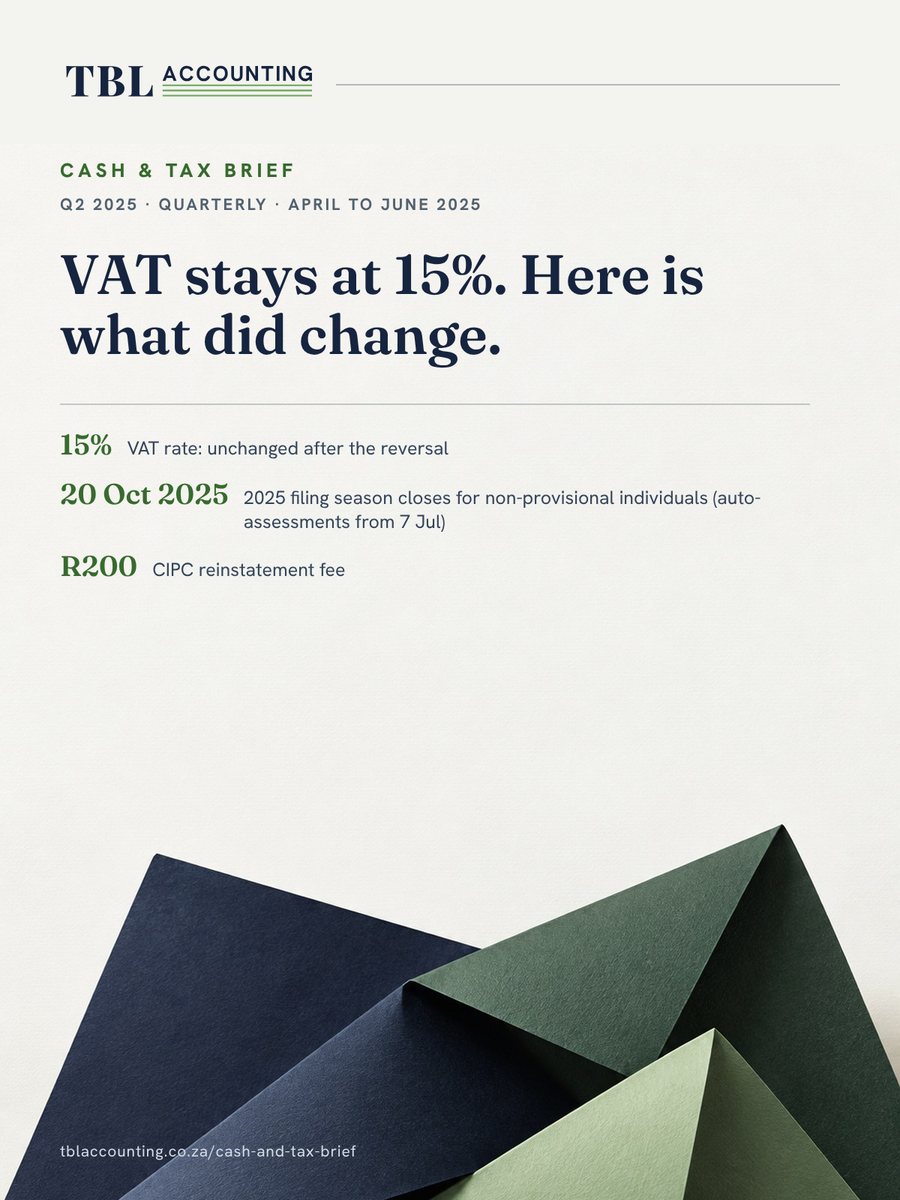
VAT stays at 15%. Here is what did change.
The VAT reversal, a Budget with no bracket relief, wider payroll incentives, the 2025 filing season, and what SARB’s new circulars mean if you are leaving South Africa.
In this edition
- VAT stays at 15%: the proposed 15.5% rise was reversed before it took effect
- 21 May Budget: no bracket relief for 2025/26, R20bn of new tax flagged for 2026
- ETI widened from 1 April 2025: pay limit R7,500, up to R1,500 a month (enacted 2026)
- 2025 filing season set: 7 Jul to 20 Oct, provisional taxpayers and trusts to 19 Jan
- SARS return changes: foreign CGT credits carry forward, labour brokers, residency date
- CIPC reinstatement: R200 fee, and outstanding annual returns due within 30 days
- Leaving SA? SARB circulars tie offshore transfers to SARS tax-compliance checks
- UK non-dom regime ended 6 April 2025: residence-based FIG relief and IHT
Lead story
VAT stays at 15%: the proposed 15.5% rise was reversed before it took effect
What changed. The 12 March 2025 Budget Review proposed VAT of 15.5% from 1 May 2025 and 16% from 1 April 2026, plus extra zero-rated foods. The Minister announced the suspension on 23 April 2025, the Western Cape High Court ratified a settlement suspending the 12 March decision on 27 April, and the 21 May 2025 Budget confirmed VAT stays at 15% and withdrew the zero-rating expansion. The Rates and Monetary Amounts and Amendment of Revenue Laws Act, 2026 (Act 3 of 2026, published in Government Gazette 54446 on 1 April 2026) stops the VAT rate change from taking effect, deemed from 1 May 2025.
What it means for you. No change to the VAT you charge or claim: the 15.5% rate never took effect. The cost moved elsewhere: Treasury put the medium-term revenue shortfall at about R75bn, and the 21 May Budget Overview says the Minister will propose an additional R20bn in tax measures in the 2026 Budget.
What we’d do. Check your accounting software and invoice templates are on 15% and that no 15.5% transactions were captured, and keep new-tax risk in your 2026/27 cash plan.
Tax and SARS
21 May Budget: no bracket relief for 2025/26, R20bn of new tax flagged for 2026
What changed. The 21 May 2025 Budget did not adjust personal income tax brackets and rebates for inflation, and the Budget Overview lists no inflationary adjustment to medical tax credits. The 2025/26 individual table therefore runs from 18% on the first R237,100 to 45% above R1,817,000. The small business corporation table tops out at 27% above R550,000 and micro-business turnover tax at 3% above R750,000 (0% up to R335,000). The Budget Speech said the 2026 Budget would need to propose new tax measures aimed at raising R20bn. The 2025/26 rates were legislated in Schedule I of the Rates and Monetary Amounts and Amendment of Revenue Laws Act, 2026 (Act 3 of 2026, published 1 April 2026).
What it means for you. Because thresholds do not move with inflation, extra salary you earn in 2025/26 is taxed in higher brackets than it would be with indexation. The Budget Speech also said SARS collecting at least R35bn more could cover the R20bn gap, so new measures for 2026 were not a certainty.
What we’d do. Review owner pay (salary versus dividends) against the 2025/26 tables before year-end and leave headroom in the 2026/27 plan for Budget changes.
Sources (1)
2025 filing season set: 7 Jul to 20 Oct, provisional taxpayers and trusts to 19 Jan
What changed. SARS announced the 2025 filing season runs 7 July to 20 October 2025. Auto-assessed taxpayers are notified 7 to 20 July; non-provisional individuals who must file close on 20 October; provisional taxpayers (except trusts) can file from 21 July 2025 to 19 January 2026; trusts from 20 September 2025 to 19 January 2026.
What it means for you. Owners and directors who are non-provisional must file or confirm their assessment by 20 October 2025; provisional taxpayers and trusts have until 19 January 2026.
What we’d do. Diarise the right closing date for each person and entity and gather IRP5s, medical certificates, logbooks and investment certificates before the window opens.
Sources (1)
SARS return changes: foreign CGT credits carry forward, labour brokers, residency date
What changed. On 26 June 2025 SARS listed 2025 filing-season changes: from 1 March 2025 credits for foreign tax paid on capital gains can be fully used and unused credits carry forward automatically for up to six years; approved labour brokers (with a certificate of exemption) fall within the definition of provisional taxpayer; the section 12H learnership termination date moves from 1 April 2024 to 31 March 2027; eligible provisional taxpayers can be invited to opt in to auto-assessment; and the return now has a 'Reinstatement Date of RSA Tax Residency' field for people who previously ceased and later regained SA tax residency.
What it means for you. Foreign tax paid on capital gains can now be credited in full with a six-year carry-forward. Labour brokers pick up IRP6 provisional filing. Returning expats must declare when SA tax residency resumed.
What we’d do. Returning expats: document the date SA tax residency resumed before filing. Labour brokers: diarise IRP6 periods. Anyone with foreign gains: check the credit carry-forward.
Sources (1)
Payroll and employers
ETI widened from 1 April 2025: pay limit R7,500, up to R1,500 a month (enacted 2026)
What changed. Employment Tax Incentive changes announced in the March 2025 Budget (SARS notice dated 28 March 2025) raise the monthly remuneration limit from R6,500 to R7,500 and start the full-incentive band at R2,500 (was R2,000). The incentive is R1,500 a month in the first 12 months and R750 in the second 12 for remuneration of R2,500 to R5,499.99, tapering to nil at R7,500; the Budget Review says the R1,500 maximum itself is unchanged. SARS first said the changes depended on Parliament passing the legislation. The Rates and Monetary Amounts and Amendment of Revenue Laws Act, 2026 (Act 3 of 2026, published in Government Gazette 54446 on 1 April 2026) enacted them, deemed in operation from 1 April 2025.
What it means for you. More low-paid staff can qualify: employees earning between R6,500 and R7,500 a month now fall within the incentive and the full-incentive band is wider. The maximum per employee does not rise. The Act is deemed to apply from 1 April 2025.
What we’d do. Check payroll software carries the 1 April 2025 ETI table and re-test which employees qualify, then reconcile the claim on EMP201 and EMP501.
Company filings (CIPC)
CIPC reinstatement: R200 fee, and outstanding annual returns due within 30 days
What changed. CIPC Notice 18 of 2025 set out manual reinstatement of deregistered companies and close corporations: apply to one mailbox with R200 available in the CoR40.5 customer code, then file all outstanding annual returns and AFS/FAS within 30 days of reinstatement or fall back to final deregistration. The beneficial ownership declaration requirement is relaxed to complete reinstatement but must be filed afterwards.
What it means for you. If CIPC deregistered the company for missing annual returns or BO filings, getting back costs R200 per application plus catching up all outstanding returns within a short window; a missed catch-up sends it back to final deregistration. From 11 August 2025 the process is online and the catch-up period is 30 business days.
What we’d do. Check each company's CIPC status on BizPortal, file the outstanding annual returns and BO declarations before any deregistration, and keep evidence of trading.
Sources (2)
Across borders: the UK and abroad
Leaving SA? SARB circulars tie offshore transfers to SARS tax-compliance checks
What changed. Exchange Control Circulars 12/2025 and 13/2025 (19 June 2025) amend the Authorised Dealer Manual. Circular 12 says Authorised Dealers must use the SARS Tax Compliance Status (TCS) PIN to verify a resident individual's tax compliance via SARS eFiling before effecting transfers, and should not transfer where the status shows non-compliance. For individuals who cease to be SA tax resident, Circular 13 allows private individuals aged 18 or older who are tax compliant to transfer up to R10 million per calendar year (with the applicable TCS application) and a once-off R1 million travel allowance in the year residency ceases without a TCS PIN letter. It also says that, in certain cases, retirement-fund lump sums will only be allowed by SARS if the member has remained tax non-resident for at least three consecutive years. Neither circular states a separate effective date.
What it means for you. Moving money out of SA when you emigrate or cease tax residency depends on SARS compliance sign-off. For retirement-fund lump sums, a three-year non-residence condition applies in certain cases, a condition the circular does not further explain.
What we’d do. Before you cease SA tax residency, get your SARS affairs and TCS status in order and plan the timing of any retirement-fund withdrawals with the three-year condition in mind.
UK non-dom regime ended 6 April 2025: residence-based FIG relief and IHT
What changed. From 6 April 2025 the UK replaced domicile-based rules with a tax-residence system. Individuals who become UK resident after at least 10 consecutive tax years of non-UK residence can claim foreign income and gains relief for up to four years; pre-6 April 2025 foreign income and gains can be designated under the Temporary Repatriation Facility at 12% in 2025-26 and 2026-27 and 15% in 2027-28; inheritance tax now turns on being UK resident in at least 10 of the last 20 tax years.
What it means for you. South Africans who arrive after a long absence from the UK get four years of relief on foreign income and gains, after which worldwide income is taxed as it arises. Long-term UK residents (10 of the last 20 tax years) bring non-UK assets, such as SA property, into UK inheritance tax, for 3 to 10 years after leaving.
What we’d do. Count your UK residence years now, flag when you pass 10 of 20, and plan the timing of any SA asset or remittance decisions with a UK adviser.
Get the Brief by email
General information only, correct at the date of the edition and based on the sources cited. It is not tax, legal or investment advice. Speak to your adviser before acting. The Cash & Tax Brief is general information for South African businesses and South Africans abroad. It is not tax, legal or financial advice, and it reflects the public sources linked in each item at the date shown. Rules change and proposals may not become law, so confirm the current position before you act. Information about the UK is general and is not UK tax advice.