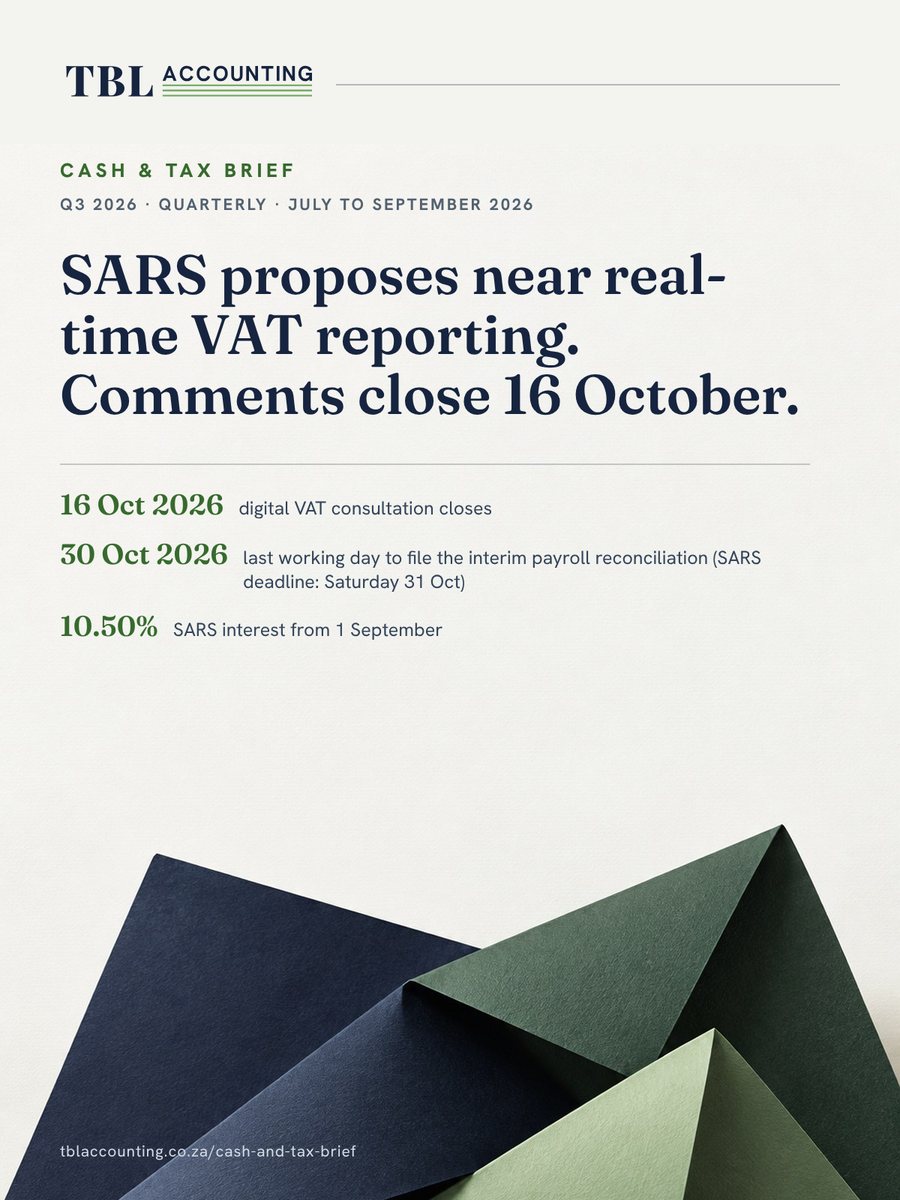
SARS proposes near real-time VAT reporting. Comments close 16 October.
The digital VAT model consultation, draft 2026 tax bills, the interim payroll reconciliation, trust filing season, a higher SARS interest rate, and the dates ahead to March 2027.
In this edition
- SARS consults on e-invoicing and near real-time VAT reporting; comments close 16 October
- Draft 2026 tax bills out: VAT-rate mechanism, spouse gifts, micro-business rule
- VAT threshold change still not law in September; SARS applies it but cancels nothing automatically
- Auto-assessed provisional taxpayers get until 22 Jan 2027 to push back
- Interim EMP501 window open to 31 October; late penalty starts at 1% of annual PAYE
- Trust filing season runs to 22 Jan 2027; SARS starts its trust non-compliance penalty framework
- SARS interest on tax owed ticks up to 10.50% from 1 September
- Compensation Fund final reminder: overdue COIDA returns before 31 October
- SARS Interpretation Note 145: ETI claims for trainees need real work for the paying employer; onus is on the claimant
- UK Budget set for 28 October 2026
- First UK Making Tax Digital quarterly update fell due on 7 August
Lead story
SARS consults on e-invoicing and near real-time VAT reporting; comments close 16 October
What changed. SARS's August 2026 consultation paper proposes a Digital VAT Model built on e-invoicing, an interoperability framework and e-reporting, to be introduced with a pilot, then voluntary and later mandatory adoption. Written feedback closes 16 October 2026 through a SARS online survey. The paper's indicative timeline has phased implementation commencing in the 2030 calendar year and running about 36 months. It is a consultation paper and the proposals may change.
What it means for you. No cost today. If the proposals proceed, VAT-registered businesses may need accounting software that can issue e-invoices and report to SARS in near real time; this would be a long-lead software and process change.
What we’d do. Check whether your accounting platform has an e-invoicing roadmap, and submit comments through the SARS survey by 16 October if the proposals affect you.
Tax and SARS
Draft 2026 tax bills out: VAT-rate mechanism, spouse gifts, micro-business rule
What changed. National Treasury and SARS published the 2026 draft Taxation Laws Amendment Bill (TLAB) and draft Tax Administration Laws Amendment Bill (TALAB) on 30 July 2026, with comments due by 28 August 2026 (now closed). As drafted, the TLAB would let a VAT rate change announced in the Budget take effect from a date set by the Minister, for 12 months pending Parliament passing legislation (clause 31); limit the inter-spousal donations tax exemption to spouses who are South African tax residents, deemed from 25 February 2026 (clause 17); and amend the micro business election rules from 1 January 2027 (clause 21). These are drafts and may change.
What it means for you. Nothing here is law yet. If enacted as drafted, a Budget-announced VAT rate change could take effect before Parliament votes, and gifts to a non-resident spouse made on or after 25 February 2026 could lose the donations tax exemption.
What we’d do. Track the bills through Parliament and, if you have a non-resident spouse, review planned gifts between spouses against the draft wording before it is finalised.
VAT threshold change still not law in September; SARS applies it but cancels nothing automatically
What changed. SARS's VAT Connect of 8 September 2026 says the proposed higher registration thresholds (R2.3 million compulsory, R120,000 voluntary) will be retrospective once promulgated, that SARS is applying the new compulsory threshold to new registration and deregistration requests from 1 April 2026, and that VAT registrations will not be cancelled automatically at this point. On 30 September 2026 Parliament's Finance Committee held public hearings on the 2026 Rates Bill (which proposes changes to VAT thresholds), the TLAB and the TALAB.
What it means for you. The thresholds are not yet law. SARS says it may initiate cancellation for vendors below the new voluntary threshold only after the legislation is promulgated and those vendors have been notified.
What we’d do. Do not deregister on your own initiative: apply to SARS, wait for its confirmation, and watch for a notification if your supplies are under R120,000.
Auto-assessed provisional taxpayers get until 22 Jan 2027 to push back
What changed. SARS Notice 7958 (Gazette 55438, 25 September 2026) extends to 22 January 2027 the deadline for provisional taxpayers who received an automatic assessment, issued on or before 24 November 2026, to request a reduced or additional assessment. The 2026 filing season runs from 13 July, after auto-assessments from 1 to 12 July.
What it means for you. If SARS auto-assessed you as a provisional taxpayer and the numbers are wrong, you have until 22 January 2027 to correct; if you were not auto-assessed, payment is due within 30 days of the notice of assessment.
What we’d do. Compare any auto-assessment with your management accounts and file a correction well before 22 January 2027.
Trust filing season runs to 22 Jan 2027; SARS starts its trust non-compliance penalty framework
What changed. SARS opened trust filing season on 19 September 2026, with a closing date of 22 January 2027 for both provisional and non-provisional trusts; the IT3(t) third-party data return was due on 30 September 2026. SARS says its administrative non-compliance penalty framework for trust filing obligations coincides with this season, and Notice 7314 (27 March 2026) makes a trust's failure to file an income tax return within 21 business days of a final demand subject to a fixed-amount penalty.
What it means for you. Family or business trusts that miss a return after a final demand now face fixed-amount penalties; the trust return also now includes a beneficial-ownership declaration page.
What we’d do. Confirm each trust has a registered representative on eFiling, that its IT3(t) (due 30 September 2026) was submitted, and that the ITR12T is on the calendar for 22 January 2027.
SARS interest on tax owed ticks up to 10.50% from 1 September
What changed. SARS's interest rate on outstanding taxes (Table 1) moved from 10.25% (1 March to 31 August 2026) to 10.50% from 1 September 2026, to apply until the PFMA rate changes. The same table covers interest payable on certain refunds of tax.
What it means for you. SARS's Table 1 rate for interest on outstanding taxes is now 10.50% a year, up from 10.25%. Check which rate applies to the particular tax or refund concerned.
What we’d do. Clear overdue balances, or ask SARS for a payment arrangement, before interest and penalties accumulate.
Payroll and employers
Interim EMP501 window open to 31 October; late penalty starts at 1% of annual PAYE
What changed. The Employer Interim Reconciliation (EMP501) submission period runs from 21 September to 31 October 2026 and covers 1 March to 31 August 2026. Late submission attracts administrative penalties equal to 1% of annual PAYE, increasing by 1% for every month the return remains outstanding, up to a maximum of 10%. 31 October 2026 is a Saturday.
What it means for you. A late interim reconciliation can cost a percentage of a full year's PAYE, so the penalty grows with payroll size.
What we’d do. Reconcile EMP201 totals to payroll, review the pre-populated interim IRP5/IT3(a) figures, and file the interim EMP501 by Friday 30 October.
Sources (2)
Compensation Fund final reminder: overdue COIDA returns before 31 October
What changed. Compensation Fund Notice 4140 of 2026 (8 September 2026) is a final reminder to submit outstanding Returns of Earnings for 2025 and prior years. If an employer does not submit before 31 October 2026, the Commissioner may raise an assessment on an earnings-estimate basis (section 83(6)(a)) and impose a penalty not exceeding 10% of the final assessment (section 83(6)(b)). 'Before 31 October' means by Friday 30 October, as 31 October is a Saturday.
What it means for you. An estimated assessment can overstate your COIDA payroll cost, and a penalty of up to 10% of the final assessment can be added.
What we’d do. Check the Compensation Fund online account for any unfiled prior-year returns and file them before 31 October.
SARS Interpretation Note 145: ETI claims for trainees need real work for the paying employer; onus is on the claimant
What changed. SARS Interpretation Note 145 (27 July 2026) deals with the meaning of 'employee' for the Employment Tax Incentive, limited to composite arrangements typically involving learning institutions. It says substance over legal form will be considered when assessing ETI eligibility, that the onus of proving the ETI Act requirements are met rests on the claiming taxpayer, and that a person who is trained by another person but not paid for work done for that person does not meet the 'works for another person' requirement. It also records the section 5(3) penalty: 100% of the ETI received for that employee for each month in which ETI was received on an amount that must be disregarded under the proviso to 'monthly remuneration' (non-cash payments and salary sacrifices), for years of assessment starting on or after 1 March 2025.
What it means for you. Employers claiming ETI through trainee or learnership arrangements risk disallowed claims and a penalty equal to 100% of the ETI received for each affected month.
What we’d do. Review each ETI claim for evidence that the person works for, and is paid by, the claiming employer, and keep records for five years from submission of the return (the note cites section 29 of the Tax Administration Act).
Across borders: the UK and abroad
UK Budget set for 28 October 2026
What changed. The Chancellor confirmed in a letter to the Treasury Select Committee, published on GOV.UK on 31 July 2026, that the UK Budget will be held on 28 October 2026, accompanied by the OBR economic and fiscal forecast.
What it means for you. Any change to UK income tax, dividend, CGT or property rates would be announced on that day if the Chancellor chooses to make it.
What we’d do. Diarise 28 October and review any time-sensitive UK tax decisions once the Budget measures are known.
First UK Making Tax Digital quarterly update fell due on 7 August
What changed. HMRC reminded sole traders and landlords earning more than £50,000 that the first Making Tax Digital for Income Tax quarterly update was due by 7 August 2026.
What it means for you. Those in scope who missed it get no penalty points in the first 12 months (for April 2026 joiners), but the habit of quarterly reporting starts now.
What we’d do. Confirm your software is submitting each quarterly update and that the 2025-26 Self Assessment return (due 31 January 2027) is on the calendar.
Dates ahead: October 2026 to March 2027
Dates are shown as SARS applies them when the usual due date falls on a weekend or public holiday. VAT dates are for eFiling vendors, and the VAT category you are on decides which months apply to you. Confirm against SARS before you rely on a date.
| Date | What is due |
|---|---|
| 16 Oct 2026 | SARS digital VAT model consultation closes Written feedback to SARS. |
| 23 Oct 2026 | Filing season closes for non-provisional individuals For individuals not auto-assessed, or disputing an auto-assessment (13 July to 23 October 2026). |
| 28 Oct 2026 | UK Budget UK Autumn Budget and OBR forecast. |
| 30 Oct 2026 | Interim payroll reconciliation (EMP501) SARS states 31 October, a Saturday: file by Friday 30 October. Penalty starts at 1% of annual PAYE and rises 1% a month to 10%. |
| 30 Oct 2026 | VAT201 for the period ended 30 September (eFiling vendors) SARS: last business day of the month for eFiling vendors. Non-eFiling vendors: 23 October (the 25th is a Sunday). |
| 30 Oct 2026 | Overdue COIDA Returns of Earnings Compensation Fund Notice 4140 says before 31 October 2026, so file by Friday 30 October. |
| 31 Oct 2026 | UK paper Self Assessment return (2025 to 2026) Must be received by 11:59pm. Online return and payment: 31 January 2027. |
| 6 Nov 2026 | EMP201 for October (PAYE, UIF, SDL) The 7th is a Saturday, so SARS moves it to the last business day before. |
| 30 Nov 2026 | VAT201 for the period ended 31 October (eFiling) Last business day of November. |
| 7 Dec 2026 | EMP201 for November |
| 31 Dec 2026 | VAT201 for the period ended 30 November (eFiling) Last business day of December. |
| 7 Jan 2027 | EMP201 for December |
| 22 Jan 2027 | Provisional taxpayers and trusts: 2026 returns Also the extended window to dispute an auto-assessment under Notice 7958 (for assessments issued on or before 24 November 2026). |
| 29 Jan 2027 | VAT201 for the period ended 31 December (eFiling) The 31st is a Sunday, so the last business day is Friday 29 January. |
| 31 Jan 2027 | UK online Self Assessment return and payment (2025 to 2026) 11:59pm. Second payment on account: 31 July. |
| 5 Feb 2027 | EMP201 for January The 7th is a Sunday, so Friday 5 February. |
| 26 Feb 2027 | Second provisional tax payment and second turnover tax payment For 28 February 2027 year-ends: the 28th is a Sunday, so the last business day before it. Other year-ends differ. |
| 26 Feb 2027 | VAT201 for the period ended 31 January (eFiling) Last business day of February. |
| 5 Mar 2027 | EMP201 for February The 7th is a Sunday, so Friday 5 March. |
| 31 Mar 2027 | VAT201 for the period ended 28 February (eFiling) Last business day of March. |
Get the Brief by email
General information only, correct at the date of the edition and based on the sources cited. It is not tax, legal or investment advice. Speak to your adviser before acting. The Cash & Tax Brief is general information for South African businesses and South Africans abroad. It is not tax, legal or financial advice, and it reflects the public sources linked in each item at the date shown. Rules change and proposals may not become law, so confirm the current position before you act. Information about the UK is general and is not UK tax advice.