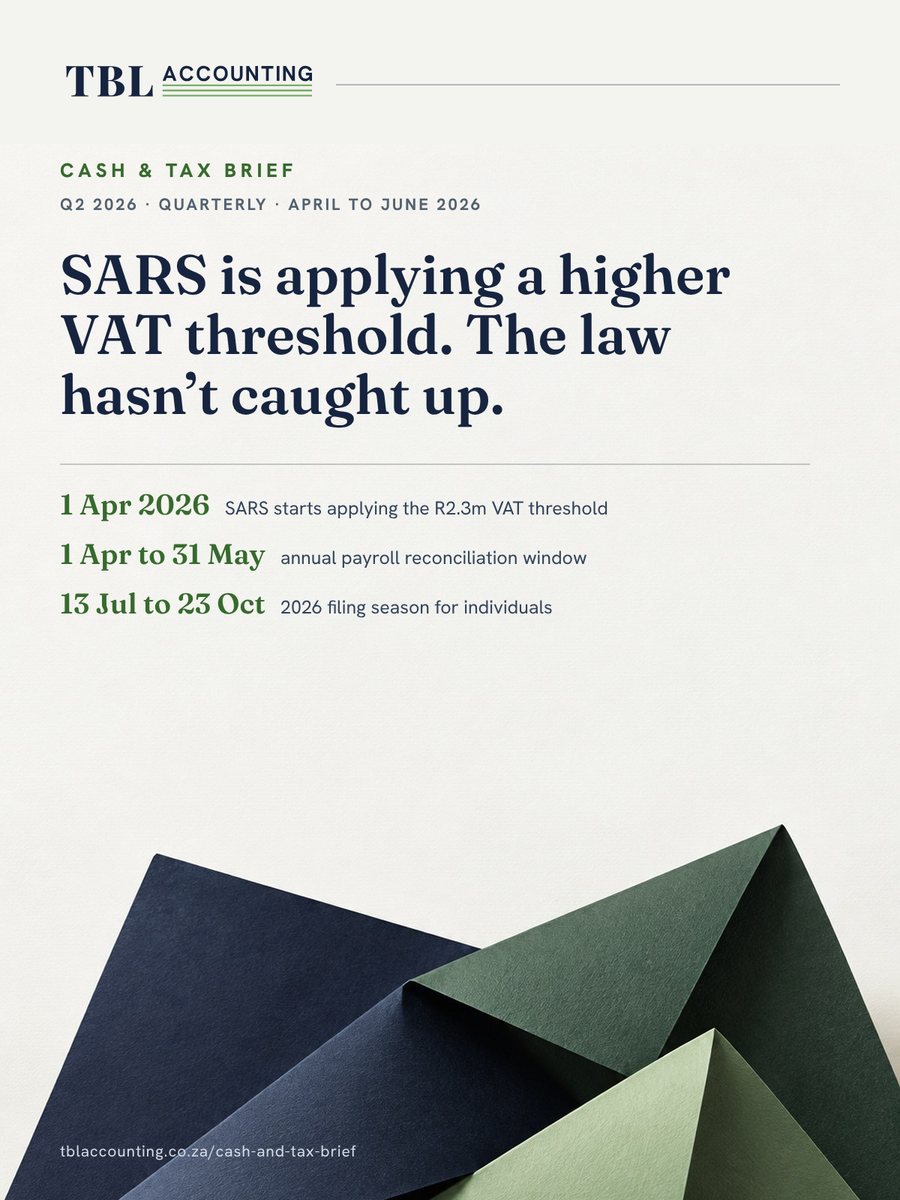
SARS is applying a higher VAT threshold. The law hasn’t caught up.
SARS applies the R2.3m threshold before it is law, the 2025 VAT rise is formally switched off, annual payroll and COIDA windows, and the 2026 filing season.
In this edition
- SARS is applying a R2.3m VAT registration threshold from 1 April, but the law is not yet passed
- Act 3 of 2026 confirms the 2025 VAT rate rise never took effect; VAT stays at 15%
- Annual EMP501 window ran 1 April to 31 May 2026
- COIDA Return of Earnings window ran 1 April to 30 June 2026; a 10% penalty applies if late
- SARS 2026 filing dates set: 13 July to 23 October, provisional 22 Jan
- Provisional taxpayers can now be auto-assessed; loss ring-fencing now starts at 39% marginal rate
- VAT Act amendments promulgated 1 April 2026: housing subsidies, e-service intermediaries, insurance definition
- UK Making Tax Digital starts for landlords and sole traders over £50k
Lead story
SARS is applying a R2.3m VAT registration threshold from 1 April, but the law is not yet passed
What changed. The 2026 Budget proposes raising the compulsory VAT registration threshold from R1 million to R2.3 million of taxable supplies in any 12-month period, and the voluntary threshold from R50,000 to R120,000, with effect from 1 April 2026. SARS says the amendments have not yet been promulgated: they sit in the draft Rates and Monetary Amounts and Amendment of Revenue Laws Bill, which Parliament's Finance Committee was still considering at its 30 September 2026 hearings. Meanwhile SARS is administering new registration applications (and, per its VAT Connect, deregistration requests) on the higher compulsory threshold, and says the amendments will be retrospective once promulgated.
What it means for you. If the thresholds are enacted as proposed, a business with taxable supplies between R1m and R2.3m would no longer be required to register for VAT. Existing registrations are not being cancelled automatically at this point; SARS says it may initiate cancellation for vendors below the new voluntary threshold only after promulgation and after notifying them.
What we’d do. Model your own 12-month taxable supplies against the proposed thresholds before any deregistration decision, and keep filing until SARS confirms cancellation in writing.
Tax and SARS
Act 3 of 2026 confirms the 2025 VAT rate rise never took effect; VAT stays at 15%
What changed. Rates and Monetary Amounts and Amendment of Revenue Laws Act 3 of 2026, published 1 April 2026 (Gazette 54446), provides that the VAT rate increase announced in the 12 March 2025 Budget 'does not come into effect', deemed from 1 May 2025. SARS shows the standard rate as 15%.
What it means for you. No VAT rate rise needs to be built into pricing or contracts. The 2025 reversal is now fixed in section 13 of an Act, not just a Budget-stage announcement.
What we’d do. VAT remains at 15%, so no rate change needs to go into pricing or invoicing templates. Separately, the 2026 draft Taxation Laws Amendment Bill (not law) proposes a Budget-announced rate-change mechanism; see our Q3 2026 edition.
SARS 2026 filing dates set: 13 July to 23 October, provisional 22 Jan
What changed. SARS announced a phased 2026 filing season on 18 June: auto-assessments 1 to 12 July, non-provisional individuals 13 July to 23 October 2026, provisional taxpayers 13 July 2026 to 22 January 2027 and trusts 19 September 2026 to 22 January 2027. Notice 7422 (30 April 2026) specifies who must submit 2026 returns.
What it means for you. Directors and sole proprietors who were not auto-assessed and are non-provisional face a 23 October deadline; provisional taxpayers have until 22 January 2027. Late returns attract administrative penalties.
What we’d do. Confirm which category you fall in, collect IRP5s and third-party certificates, and file ahead of the closing date rather than on it.
Provisional taxpayers can now be auto-assessed; loss ring-fencing now starts at 39% marginal rate
What changed. SARS announced on 29 June 2026 that eligible provisional taxpayers will be issued auto-assessments and, if they disagree, can amend and submit the return by 22 January 2027. The same SARS page says section 20A loss ring-fencing now applies from a 39% marginal rate (previously only at the 45% maximum marginal rate) for years of assessment beginning on or after 1 March 2026, and that the 2026 ITR12 adds new questions and date fields on tax residency.
What it means for you. Provisional taxpayers may find an assessment waiting that does not match their own numbers. Ring-fencing now reaches more taxpayers, not fewer: it starts at the 39% bracket instead of only the 45% top rate, so assessed losses of more people can be ring-fenced.
What we’d do. Check any auto-assessment against your records and correct it before 22 January 2027, and test whether section 20A now ring-fences an assessed loss.
VAT Act amendments promulgated 1 April 2026: housing subsidies, e-service intermediaries, insurance definition
What changed. SARS's VAT Connect Issue 21 (8 September 2026) says three Acts amending the VAT Act were promulgated on 1 April 2026 (Government Gazettes 54446, 54447 and 54448) and take effect on 1 April 2026 unless stated otherwise. These include: the section 8(23) zero-rating for housing subsidies now applying only to payments made under the housing subsidy scheme (Taxation Laws Amendment Act 5 of 2026, with a new transitional section 40F); intermediaries being allowed to report and account for VAT on electronic services made on behalf of a local principal (section 54(2B)); and an arrangement qualifying as insurance for VAT purposes only if a premium is paid.
What it means for you. Housing developers, intermediaries selling electronic services for local principals, and businesses relying on the old 'insurance' definition should check how these enacted changes apply to their VAT treatment.
What we’d do. Review VAT treatment in these sectors against the amended sections 8(23), 54(2B) and 1(1) 'insurance' definition.
Payroll and employers
Annual EMP501 window ran 1 April to 31 May 2026
What changed. SARS ran the Employer Annual Declaration (EMP501) season from 1 April to 31 May 2026. Late or incomplete submissions attract a penalty of 1% of the year's PAYE liability, increasing monthly up to a maximum of 10%, and reconciliations cannot be submitted without valid income tax reference numbers for employees.
What it means for you. A late or incomplete EMP501 carries a percentage-of-PAYE penalty (1% of the year's PAYE, increasing monthly to a maximum of 10%), so the cost scales with payroll size and the time outstanding.
What we’d do. Confirm the 2025/26 EMP501 shows as accepted on eFiling and that every employee has a valid tax reference number, and diarise the interim window (1 March to 31 August period, 21 September to 31 October 2026).
COIDA Return of Earnings window ran 1 April to 30 June 2026; a 10% penalty applies if late
What changed. Compensation Fund Notice 3894 of 2026 (dated 9 April 2026, Gazette of 15 April 2026) opened submission of Returns of Earnings for the 2025 assessment period from 1 April 2026 to 30 June 2026, and states that a 10% penalty would be charged for ROEs submitted late after the prescribed deadline.
What it means for you. A late ROE attracts a 10% penalty, and the notice also states that interest applies to accounts unpaid 30 days after the invoice date.
What we’d do. Confirm the Return of Earnings was submitted on the Compensation Fund online system and keep the payroll totals used, so any assessment can be checked.
Across borders: the UK and abroad
UK Making Tax Digital starts for landlords and sole traders over £50k
What changed. From 6 April 2026 sole traders and landlords with qualifying self-employment and property income above £50,000 must keep digital records and send quarterly updates through software; the threshold falls to £30,000 on 6 April 2027 and £20,000 on 6 April 2028. The first quarterly update deadline was 7 August 2026.
What it means for you. Expect software costs and more frequent reporting work if you let UK property or trade as a sole trader; the annual 2025-26 return is still due 31 January 2027.
What we’d do. Work out whether 2024-25 qualifying income puts you in the April 2026 group and, if not, whether 2025-26 income over £30,000 puts you in the April 2027 group, then choose compatible software early.
Get the Brief by email
General information only, correct at the date of the edition and based on the sources cited. It is not tax, legal or investment advice. Speak to your adviser before acting. The Cash & Tax Brief is general information for South African businesses and South Africans abroad. It is not tax, legal or financial advice, and it reflects the public sources linked in each item at the date shown. Rules change and proposals may not become law, so confirm the current position before you act. Information about the UK is general and is not UK tax advice.