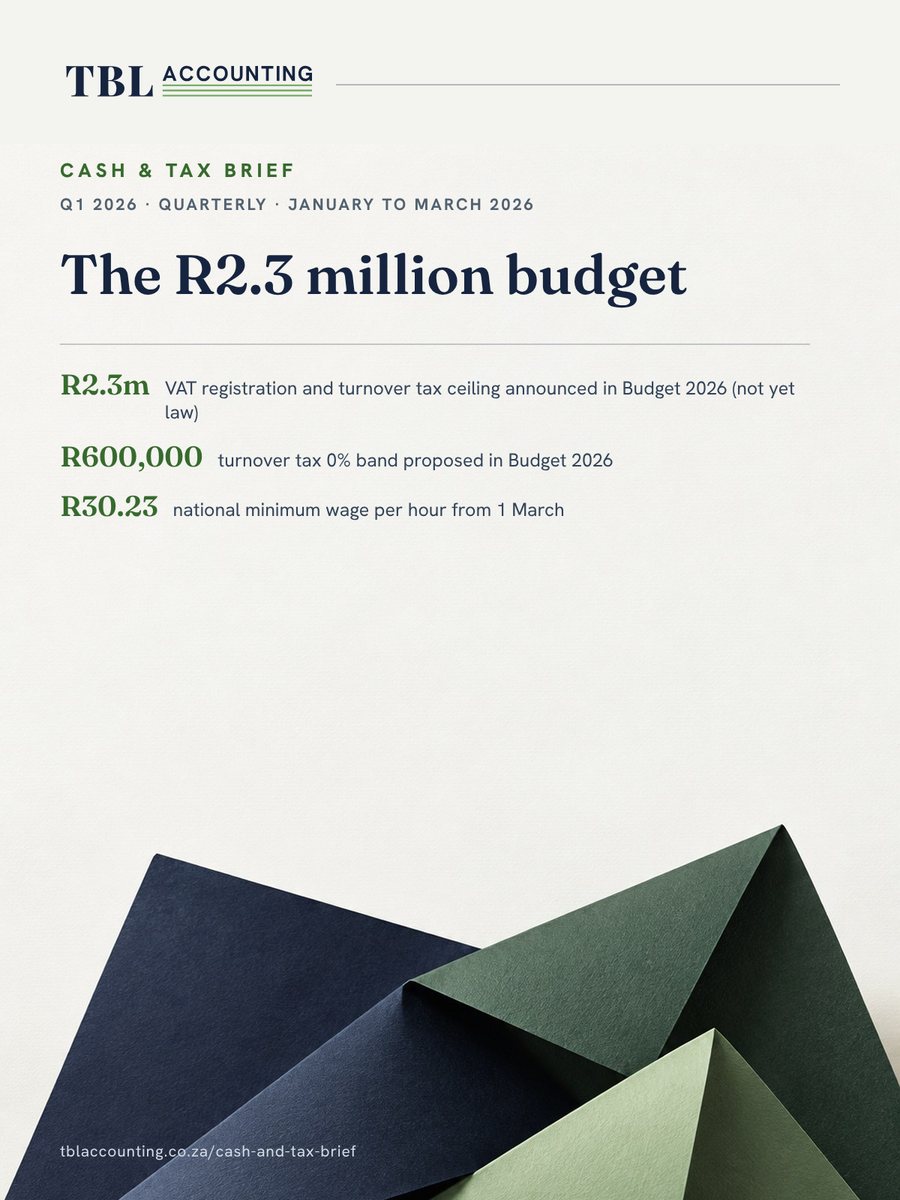
The R2.3 million budget
A higher VAT registration and turnover tax threshold announced, the R20bn tax rise dropped, a new minimum wage, bigger CGT exclusions announced, and a plan to double the offshore allowance.
In this edition
- VAT registration threshold to R2.3m and voluntary to R120k from 1 April 2026; SARS says legislation not yet promulgated
- Budget 2026 proposes turnover tax cap of R2.3m with 0% to R600k, and an SBC 0% band to R99k
- R20bn tax hike dropped; brackets and rebates up with 3.4% inflation
- National minimum wage up to R30.23 an hour from 1 March 2026
- Budget 2026 doubles the offshore allowance to R2m a year; SARB circulars apply from 8 April 2026
- Selling your business at 55+: CGT exclusion up to R2.7m, ceiling R15m
- CGT exclusion on your home rises to R3m; exclusion on death to R440,000
- SARS tax debt at R646bn; trusts with two years' returns outstanding face penalties; late-tax interest 10.25%
- UK Self Assessment due 31 Jan 2026: £100 penalty even if no tax owed
Lead story
VAT registration threshold to R2.3m and voluntary to R120k from 1 April 2026; SARS says legislation not yet promulgated
What changed. Budget 2026 (tabled 25 Feb 2026) announced an increase in the compulsory VAT registration threshold from R1 million to R2.3 million and in the voluntary threshold from R50,000 to R120,000, to be effective from 1 April 2026. SARS applies the new thresholds from 1 April 2026, but its Budget 2026 FAQ (updated 12 Aug 2026) says that 'although the amendments have not yet been promulgated' the Minister announced them to be effective from 1 April 2026.
What it means for you. SARS is applying the new thresholds to registration applications from 1 April 2026, but the legislation has not yet been passed. If it is enacted as announced, businesses with taxable supplies between R1 million and R2.3 million will no longer be required to register. Vendors already registered are not cancelled automatically and must keep charging VAT. Once the legislation is promulgated, SARS says it may cancel registrations of vendors whose taxable supplies in the preceding 12 months were under R120,000, and will notify them first (80 business days to object). On cancellation, VAT is payable on enterprise assets and trading stock still held (exit VAT), which SARS says can be paid in six equal monthly instalments.
What we’d do. Test the last 12 months of taxable supplies against R2.3 million before registering or cancelling, and model the exit VAT and lost input claims before cancelling any registration.
Tax and SARS
Budget 2026 proposes turnover tax cap of R2.3m with 0% to R600k, and an SBC 0% band to R99k
What changed. Budget 2026 proposed raising the turnover tax ceiling from R1 million to R2.3 million, with a new rate table (0% to R600,000, 1% to R950,000, 2% to R1.4 million, 3% above R1.4 million) and removal of the year-end restriction. SARS says the turnover tax changes apply from the year of assessment beginning 1 March 2026 for individuals and 1 April 2026 for companies. For small business corporations with years of assessment ending between 1 April 2026 and 31 March 2027, the 0% band would run to R99,000 (previously R95,750); the 7%, 21% and 27% rates are unchanged.
What it means for you. On the Budget 2026 proposals, a business turning over R600,000 would move from R3,650 of turnover tax under the old table to nil, and SARS puts the maximum at R39,500 on R2.3 million. An SBC with taxable income above R99,000 would pay up to about R228 a year less, because the 0% band rises from R95,750 to R99,000 and the fixed amounts fall from R18,848 to R18,620 and from R57,698 to R57,470.
What we’d do. Compare turnover tax against the SBC and normal company route on your actual margin, since the turnover tax ceiling now equals the VAT registration threshold.
R20bn tax hike dropped; brackets and rebates up with 3.4% inflation
What changed. Budget 2026 (25 Feb 2026) withdrew the R20 billion of tax increases pencilled in for the 2026 Budget and adjusted personal tax brackets and rebates for expected inflation of 3.4% (top of the 18% band R237,100 to R245,100; primary rebate R17,235 to R17,820; tax threshold under 65 R95,750 to R99,000). It also lifted the retirement deduction cap from R350,000 to R430,000 and the tax-free savings limit from R36,000 to R46,000. SARS says its employer PAYE deduction tables for 2026/27 came into effect on 1 March 2026.
What it means for you. Taxpayers pay less than they would with frozen brackets (the primary rebate alone is R585 higher), and employers must load the new PAYE tables. The Budget Review revised the medium-term tax revenue outlook down by R57.2 billion relative to the 2025 MTBPS, primarily due to the withdrawal of the proposed tax increases.
What we’d do. Confirm payroll is on the 2026/27 tables, and revisit director remuneration and retirement contributions against the higher R430,000 cap.
Selling your business at 55+: CGT exclusion up to R2.7m, ceiling R15m
What changed. Budget 2026 raised the capital gains tax exclusion on the disposal of a small business by a person aged 55 or older from R1.8 million to R2.7 million, and the maximum market value of the business from R10 million to R15 million. The annual CGT exclusion rose from R40,000 to R50,000. The Budget Review gives 1 March 2026 as the start (SARS's Budget FAQ gives 2 March 2026); check the date of the sale agreement, as SARS says the gain arises when the agreement is signed.
What it means for you. An older founder selling a business worth up to R15 million can shelter R900,000 more of the gain (R2.7m less R1.8m) from CGT.
What we’d do. If a sale is on the horizon, check the business's market value against the R15 million ceiling and the owner's age before signing, since the exclusion depends on both.
CGT exclusion on your home rises to R3m; exclusion on death to R440,000
What changed. Budget 2026 raised the capital gains tax primary residence exclusion from R2 million to R3 million and the exclusion on death from R300,000 to R440,000. The Budget Review gives 1 March 2026 as the start (SARS's Budget FAQ gives 2 March 2026); check the date of the sale agreement, as SARS says the gain arises when the agreement is signed.
What it means for you. A gain on the sale of a primary residence of up to R3 million is excluded, R1 million more than before. On death, R440,000 of gains is excluded, R140,000 more.
What we’d do. If you plan to sell a home or are reviewing an estate, check which exclusion applies and what date the disposal falls on.
SARS tax debt at R646bn; trusts with two years' returns outstanding face penalties; late-tax interest 10.25%
What changed. At 31 January 2026 total outstanding tax debt was R646 billion, of which R518.2 billion was undisputed. By that date SARS had collected R79.4 billion of tax debt against a target of R95 billion for the period, and the Budget Review says it is unlikely the full-year target will be met. SARS says trusts with both 2024 and 2025 income tax returns outstanding face administrative penalties from 2 March 2026 (the penalty applies after a final demand: see our Q3 2026 edition). SARS's interest table shows the rate on outstanding tax fell to 10.25% from 1 March 2026.
What it means for you. Expect continued SARS collection activity, including third-party appointments (Form AA88) under section 179 of the Tax Administration Act. Interest on late tax was 10.25% from 1 March 2026 (SARS's table shows 10.50% from 1 September 2026).
What we’d do. Clear or formally arrange any outstanding SARS balance and file overdue returns, including for trusts, before enforcement steps start.
Payroll and employers
National minimum wage up to R30.23 an hour from 1 March 2026
What changed. The Minister of Employment and Labour announced on 3 Feb 2026 that the National Minimum Wage rises from R28.79 to R30.23 per ordinary hour (R1.44), binding from 1 March 2026.
What it means for you. Every ordinary hour for minimum-wage staff, including domestic and farm workers, costs R1.44 more. SARS also states that if any employee is paid below the minimum wage, the employer's entire ETI claim is disqualified.
What we’d do. Re-check the lowest paid roles and hourly rates against R30.23 before the March payroll, since an underpayment can also cost the ETI claim.
Also worth knowing
Budget 2026 doubles the offshore allowance to R2m a year; SARB circulars apply from 8 April 2026
What changed. Budget 2026 (25 Feb 2026) announced that the Single Discretionary Allowance would double from R1 million to R2 million a year. SARB Exchange Control Circulars 6/2026 and 7/2026, both dated 8 April 2026, implement it 'effective from the date of this Circular', so the change took effect on 8 April 2026 (Q2 2026). The travel allowance for residents under 18 rises to R400,000 (from R200,000). Circular 6/2026 also lets a person who has ceased to be a resident transfer up to R2 million as a once-off travel allowance in the year they cease residency, without a TCS PIN letter.
What it means for you. Residents aged 18 and over can use up to R2 million a year under the single discretionary allowance (SARS notes married couples can collectively transfer R4 million). Circular 7/2026 requires authorised dealers with limited authority (ADLAs) to obtain and verify the source of funds for client transactions above R50,000 a day in aggregate.
What we’d do. If planning offshore transfers or emigrating, line up proof of source of funds before transferring.
Across borders: the UK and abroad
UK Self Assessment due 31 Jan 2026: £100 penalty even if no tax owed
What changed. HMRC reminded taxpayers that the 2024-25 Self Assessment return deadline was 31 January 2026 (a Saturday). Late returns get an initial £100 penalty, then £10 a day after 3 months up to £900, then 5% of tax due or £300 (whichever is greater) at 6 and at 12 months.
What it means for you. South Africans in the UK with rental, self-employment or foreign income filing late pay a fixed £100 penalty even if no tax is due, plus 5% penalties on unpaid tax at 30 days, 6 months and 12 months. The next deadline is 31 January 2027 for the 2025-26 return.
What we’d do. Gather SA and UK income records early, register for Self Assessment if new, and file before January rather than on deadline day.
Get the Brief by email
General information only, correct at the date of the edition and based on the sources cited. It is not tax, legal or investment advice. Speak to your adviser before acting. The Cash & Tax Brief is general information for South African businesses and South Africans abroad. It is not tax, legal or financial advice, and it reflects the public sources linked in each item at the date shown. Rules change and proposals may not become law, so confirm the current position before you act. Information about the UK is general and is not UK tax advice.