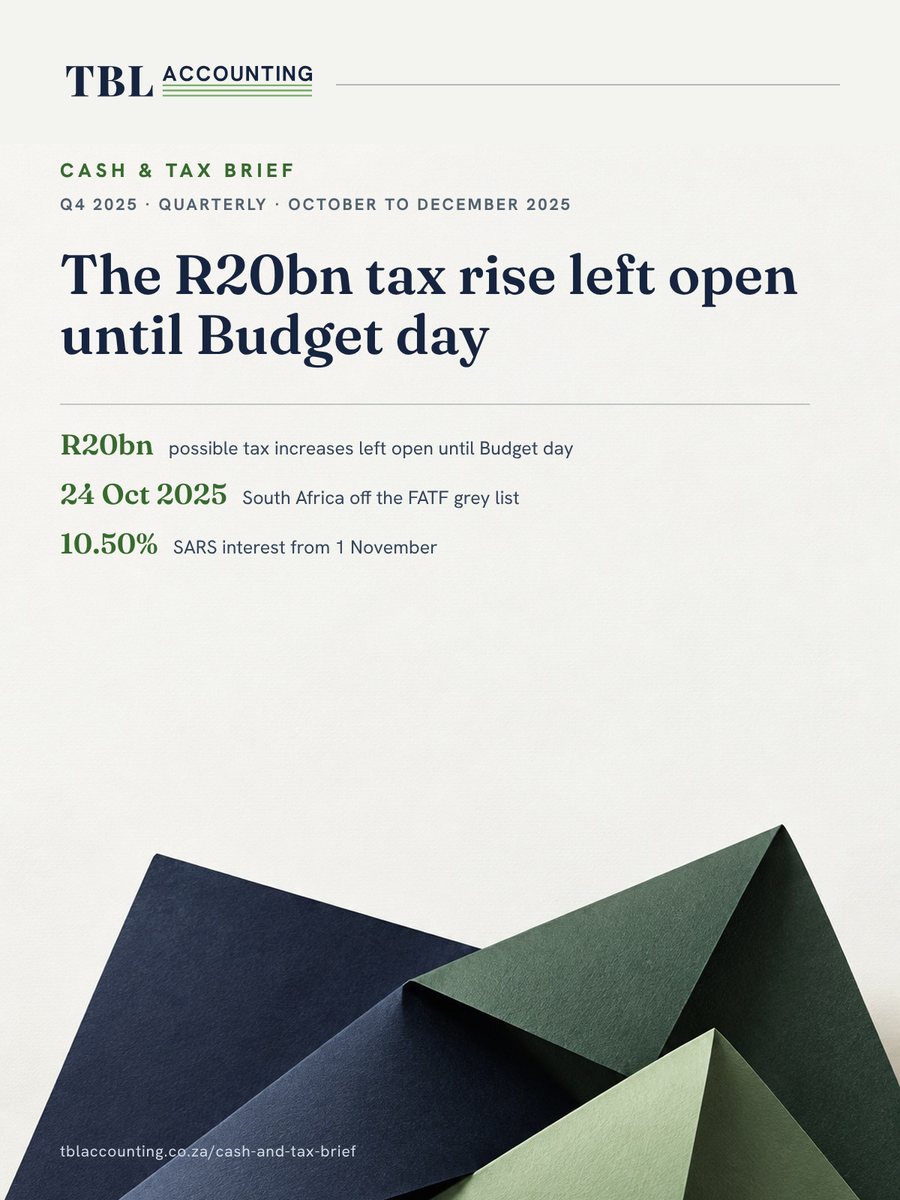
The R20bn tax rise left open until Budget day
The Medium-Term Budget, bills on premises inspections and loss ring-fencing, SARS interest, CIPC checklist warnings, South Africa leaving the grey list, and UK dividend tax.
In this edition
- MTBPS: R20bn tax increase left open until the 2026 Budget; no new tax rates in the speech
- SARS may inspect, without notice, the premises of applicants for tax registration or approval (Act published 1 April 2026)
- Loss ring-fencing now starts at the 39% bracket, not the 45% top rate
- Filing season 2025: 20 Oct for most, 19 Jan 2026 for provisional and trusts
- Interim EMP501 window closed 31 Oct 2025; late-filing penalty starts at 1% of annual PAYE and rises to 10%
- SARS late-tax interest fell to 10.50%; staff-loan benefit rate 7.75% from Dec
- SARS says VAT applicants will get clarity on extra documents required and reasons for rejection
- CIPC warns that knowingly false answers on the annual compliance checklist are an offence
- Voluntary deregistration goes fully online from 8 Dec 2025, about two months
- South Africa off the FATF grey list from 24 October 2025
- UK Budget announces dividend tax rise of 2 points from April 2026, thresholds frozen to 2031
Lead story
MTBPS: R20bn tax increase left open until the 2026 Budget; no new tax rates in the speech
What changed. In the 12 Nov 2025 MTBPS the Minister said an assessment of revenue performance would inform whether the R20 billion of additional tax increases pencilled in for the 2026 Budget could be dropped, with a final decision to be announced in the 2026 Budget. He announced a new inflation target of 3% with a 1 percentage point tolerance band, immediately replacing the 3-6% range. The speech noted that an additional R4 billion allocated to SARS (as indicated in the 2025 Budget) is meant partly to strengthen debt collection, to raise collections by R20 to R50 billion a year. The speech announced no new tax rates.
What it means for you. No new tax rates were announced, but the possible R20bn increase stayed open until Budget day (25 Feb 2026, when it was withdrawn). The speech ties the SARS funding to collecting R20-50 billion more a year, so more follow-up on late filings and tax debt is likely.
What we’d do. Keep returns, provisional payments, PAYE and VAT current so extra SARS collection activity finds nothing outstanding, and settle or arrange any existing tax debt.
Sources (1)
Tax and SARS
SARS may inspect, without notice, the premises of applicants for tax registration or approval (Act published 1 April 2026)
What changed. The Tax Administration Laws Amendment Bill (explanatory summary published by SARS 7 Nov 2025, introduced 12 Nov 2025) lets a SARS official, without prior notice, inspect premises to determine whether the physical address of an applicant for registration or approval exists and whether the premises are suitable for the activities in the application (new s45(1)(bA) of the Tax Administration Act). The Bill's memorandum names voluntary VAT registration and, as a similar risk, the employment tax incentive, and says a home-based business may be inspected only in the part used for trade. The Bill also lets a taxpayer ask a senior SARS official to suspend payment of tax under an assessment while requesting a reduced assessment under s95(6) (s164(2)), and requires at least 10 business days' written notice, in the prescribed form, before High Court proceedings against the Commissioner (s11(4)). SARS records the Bill as promulgated as the Tax Administration Laws Amendment Act, 2026 (Act 4 of 2026) on 1 April 2026 (GG 54447); the s45(1)(bA) wording is in the Act as published.
What it means for you. A new registration or approval application can now trigger an unannounced visit to the address given, and a mismatch between the address and the activity could hold up the application. Suspension of payment pending a reduced assessment is a request to a senior SARS official, not automatic.
What we’d do. Before applying for registration (for example VAT), make sure the registered physical address is where the business really operates and that supporting records are on hand.
Loss ring-fencing now starts at the 39% bracket, not the 45% top rate
What changed. The Taxation Laws Amendment Bill (tabled 12 Nov 2025) lowers the s20A assessed-loss ring-fencing trigger from the maximum marginal rate to the 39% marginal rate. SARS lists it as the Taxation Laws Amendment Act, 2026 (Act 5 of 2026), promulgated 1 April 2026 (GG 54448). SARS's filing-season 2026 page (29 June 2026) confirms the final rule: for years of assessment commencing on or after 1 March 2026, s20A applies from a marginal rate of 39% rather than the maximum marginal rate (45%); the 45% trigger still applies to years of assessment ending before 1 March 2026.
What it means for you. An individual with a loss-making trade of the kind s20A targets, whose taxable income before the loss reaches the 39% bracket (it starts at R695,801 on the 2026/27 table), can now fall under the ring-fencing rules, which restrict how that loss can be set off against other income.
What we’d do. If you run a loss-making activity alongside a high salary or profit, ask your tax adviser whether s20A applies to it for years of assessment starting 1 March 2026 or later before relying on the loss.
Filing season 2025: 20 Oct for most, 19 Jan 2026 for provisional and trusts
What changed. SARS set the 2025 filing season so non-provisional individuals could file from 21 July to 20 October 2025, provisional taxpayers (except trusts) until 19 January 2026, and trusts from 20 September 2025 to 19 January 2026. Auto-assessed taxpayers had to submit any missing information by 20 October 2025.
What it means for you. SARS says submissions must comply with regulations and deadlines to avoid penalties; the release gives no penalty amounts.
What we’d do. Diarise the provisional-taxpayer and trust deadlines each year, file early, and check auto-assessments for missing income or deductions before the first closing date.
Sources (1)
SARS late-tax interest fell to 10.50%; staff-loan benefit rate 7.75% from Dec
What changed. The interest rate SARS charges on outstanding taxes fell from 10.75% to 10.50% from 1 Nov 2025. The official rate used to value interest-free or cheap staff loans fell from 8.00% to 7.75% from 1 Dec 2025.
What it means for you. Late tax costs slightly less in interest (a further cut to 10.25% followed on 1 Mar 2026). A lower official rate shrinks the taxable fringe benefit on interest-free or low-interest employee and shareholder loans.
What we’d do. Update the payroll fringe-benefit rate on any staff loans and review whether loans to directors or staff are priced at or above the official rate.
SARS says VAT applicants will get clarity on extra documents required and reasons for rejection
What changed. On 9 Dec 2025 SARS announced an enhanced VAT registration process: applicants will now receive clarity on any additional supporting documents required and specific reasons if an application is rejected.
What it means for you. Applicants should get clearer information if their VAT application needs more documents or is rejected. The announcement did not set out timelines or list the documents. Separately, the Tax Administration Laws Amendment Act, 2026 allows SARS to inspect the premises of registration applicants (see the 'SARS may inspect, without notice' item in this edition).
What we’d do. Prepare the supporting-document pack (such as proof of address and bank details) before applying so the first submission is complete.
Sources (1)
Payroll and employers
Interim EMP501 window closed 31 Oct 2025; late-filing penalty starts at 1% of annual PAYE and rises to 10%
What changed. SARS opened the Employer Interim Reconciliation (EMP501) window from 22 September to 31 October 2025, covering 1 March to 31 August 2025, with e@syFile Thin Client as the main submission channel. SARS also warned that from the February 2026 filing season employers can no longer submit reconciliations without valid income tax numbers for all employees.
What it means for you. SARS says late submission of an EMP501 attracts an administrative penalty equal to 1% of the annual PAYE liability, increasing by 1% for every month the return remains outstanding, up to a maximum of 10%. It also says employers with unused ETI forfeit it for non-submission or a non-compliant status.
What we’d do. Reconcile payroll to the EMP201 payments before the window closes and clean up missing employee tax numbers well ahead of the annual declaration.
Sources (1)
Company filings (CIPC)
CIPC warns that knowingly false answers on the annual compliance checklist are an offence
What changed. CIPC Customer Notice 53 of 2025 says CIPC 'notes with concern the trend of false and misleading submissions' on the 24-question Compliance Checklist, describes the checklist as a declaration by company directors and officers of the company's compliance status, says its Corporate Governance, Surveillance and Enforcement Unit has been monitoring compliance, that s168(2) empowers CIPC to act on its own initiative in suspected non-compliance, and that knowingly providing false information is an offence under s215 of the Companies Act.
What it means for you. The notice treats the checklist as a declaration by directors and officers, and knowingly providing false information is an offence under s215. It sets no deadline for the checklist and no penalty amount.
What we’d do. Have the company secretary or accountant check each of the 24 answers against the filed annual returns, director changes and registers before submitting.
Sources (1)
Voluntary deregistration goes fully online from 8 Dec 2025, about two months
What changed. From 8 Dec 2025 all voluntary deregistration applications for companies and close corporations must be submitted electronically, and 50% of active directors or members must confirm via OTP. CIPC expects the process to take about two months, down from four.
What it means for you. Closing a dormant company is faster, but assets and liabilities must be settled first (the notice names SARS, banks and the Central Supplier Database). Deregistration letters are free for six months after final deregistration, then R30.
What we’d do. Before deregistering a dormant entity, clear SARS and bank balances, update director or member contact details with CIPC, and check status on BizPortal.
Also worth knowing
South Africa off the FATF grey list from 24 October 2025
What changed. On 24 Oct 2025, after the FATF plenary of 22-24 October, South Africa was removed from the FATF grey list. Treasury says the next FATF mutual evaluation is expected to start in the first half of 2026 and end in October 2027.
What it means for you. No new rule for businesses was announced. Treasury expects regulated entities to keep strengthening anti-money-laundering controls, so banks and accountants will probably keep asking for source-of-funds and ownership information.
What we’d do. Keep ownership records, beneficial-ownership filings and source-of-funds documents ready for banks and advisers.
Across borders: the UK and abroad
UK Budget announces dividend tax rise of 2 points from April 2026, thresholds frozen to 2031
What changed. The UK Autumn Budget (26 Nov 2025) announced that the dividend ordinary rate rises from 8.75% to 10.75% and the upper rate from 33.75% to 35.75% from 6 April 2026 (additional rate stays 39.35%); savings and property income rates rise 2 points to 22%, 42% and 47% from 6 April 2027. The Personal Allowance (£12,570) and basic rate limit (£37,700) stay frozen for 2028-29 to 2030-31.
What it means for you. For South Africans resident in the UK who pay themselves dividends from a company, each £10,000 taxed at the ordinary rate would cost £200 more from April 2026; frozen thresholds mean more income drifts into higher bands.
What we’d do. Review the salary-versus-dividend mix for 2026-27 and any UK savings or rental income ahead of the April 2027 changes.
Get the Brief by email
General information only, correct at the date of the edition and based on the sources cited. It is not tax, legal or investment advice. Speak to your adviser before acting. The Cash & Tax Brief is general information for South African businesses and South Africans abroad. It is not tax, legal or financial advice, and it reflects the public sources linked in each item at the date shown. Rules change and proposals may not become law, so confirm the current position before you act. Information about the UK is general and is not UK tax advice.